-
 Deep Tech, Innovation & Technology Transfer in Tokyo and Kansai
DWIH Deep Tech Launchpad Japan 2026
The DWIH Deep Tech Launchpad Japan 2026 is an exclusive, collaborative program offering research-based startups and sciencepreneurs from German universities a unique opportunity to explore the innovation and technology transfer ecosystems of Tokyo and the Kansai region (Kyoto/Osaka). The program is specifically tailored for early-stage tech ventures (typically covering TRL 1–6) aiming to assess international potential, validate technology options, and connect directly with Japanese corporate partners, specialized deep-tech investors, and leading research institutions. The DWIH Deep Tech Launchpad is jointly organized and conducted by the German Center for Research and Innovation Tokyo (DWIH Tokyo), the unisphere innovation campus, and the Center for Entrepreneurship (ZfE) at the University of Rostock, in cooperation with the supporter network of the DWIH Tokyo.
-
 © iStock.com/fizkes
Call: International Journalists' Programmes (IJP)
German-Japanese Fellowship Programme 2027
[Deadline: 2027/01/02] In 2027, the International Journalist’s Programmes (IJP) will offer a fellowship program exclusively for Japan for the fourth time. This initiative reflects Japan’s strategic importance in a shifting geopolitical landscape and underscores the commitment of the German government to strengthening bilateral ties.
-
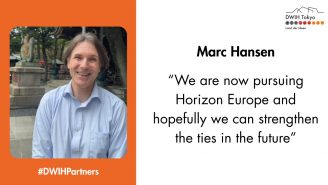 © DWIH Tokyo / Marc Hansen
A Driving Force Behind International Research Collaboration🌎
Marc Hansen
Japan’s first University of International Research Excellence – Meet our Partners in Japan Today, we’re heading north to meet Marc Hansen, Senior Research Administrator at Tohoku University in Sendai! Marc is a long-standing partner of ours and a strong advocate for international research collaboration.
-
 © DWIH/iStock/Cecilie_Arcurs
Call for Applications: eureka
Globalstars call with Japan 2026
[Deadline: 2027/01/20] This call is open for all R&D projects, excluding technologies associated with nuclear power, pharmaceutical development, and regenerative medicine product development. Examples of scope include, but are not limited to: quantum technology, artificial intelligence, robotics, semiconductors, electronics, energy and environment, biotechnology, new materials, medical devices, aerospace, mining, and other industrial technologies.
-
 © Falling Walls Lab Okinawa 2026
Call for Applications
Falling Walls Lab Okinawa 2026
[Deadline: 2026/08/31] Which wall will your research break? Pitch your innovative idea in just three minutes, showcasing a breakthrough that positively impacts science and society. Share your innovative ideas at the FALLING WALLS LAB, win a trip to the global finale in Berlin! More Information & Application: https://falling-walls.com/falling-walls-lab-okinawa-japan For the call for applications for Falling Walls Lab Sendai (deadline: May 26), please visit this page. For the call for applications for Falling Walls Lab Tokyo (deadline: July 13), please visit this page.
-
 © DWIH Tokyo / Prof. Dr. Ai Serizawa
Towards a More Sustainable Automotive Industry? 🚗🌫️
Prof. Dr. Ai Serizawa
Sustainable Materials: Meet our Partners in Japan! Guten Tag, Prof. Dr. Ai Serizawa from Shibaura Institute of Technology (SIT)! Prof. Serizawa’s research focuses on innovative and sustainable surface treatment technologies. She developed an environmentally friendly one-step process to apply a dense anticorrosive film on aluminium alloys – using nothing but steam. This technology has immense potential in industries such as the automotive and railway sectors.
-
 © DWIH Tokyo / Prof. Dr. Mehtap Özaslan / Dr. Frédéric Hasché
Pioneers in Hydrogen Research 🔋🌱♻️
Prof. Dr. Mehtap Özaslan and Dr. Frédéric Hasché
Pioneers in Japanese – German Hydrogen Research: Meet our Partners in Japan! Today, we are delighted to introduce Prof. Dr. Mehtap Özaslan and Dr. Frédéric Hasché from the University of Hamburg, Technical Electrocatalysis Laboratory.
- DWIH Tokyo
- Themen
- 2026: Science for Society
- 2025: Globale Gesundheit
- 2024: Künstliche Intelligenz: Mensch und Gesellschaft im Fokus
- 2023: Die resiliente Gesellschaft
- 2022: Nachhaltige Innovationen
- 2021: Gesellschaft im Wandel – Auswirkungen der Pandemie
- 2020: Städte und Klima
- 2019: Künstliche Intelligenz
- 2018: Innovatives Arbeiten in einer digitalisierten Welt
- Autonomes Fahren
- Nanotechnologie
- Netzwerk
- Forschung & Innovation
- Aktivitäten & Service
- Jahresberichte