
DWIH Deep Tech Launchpad Japan 2026
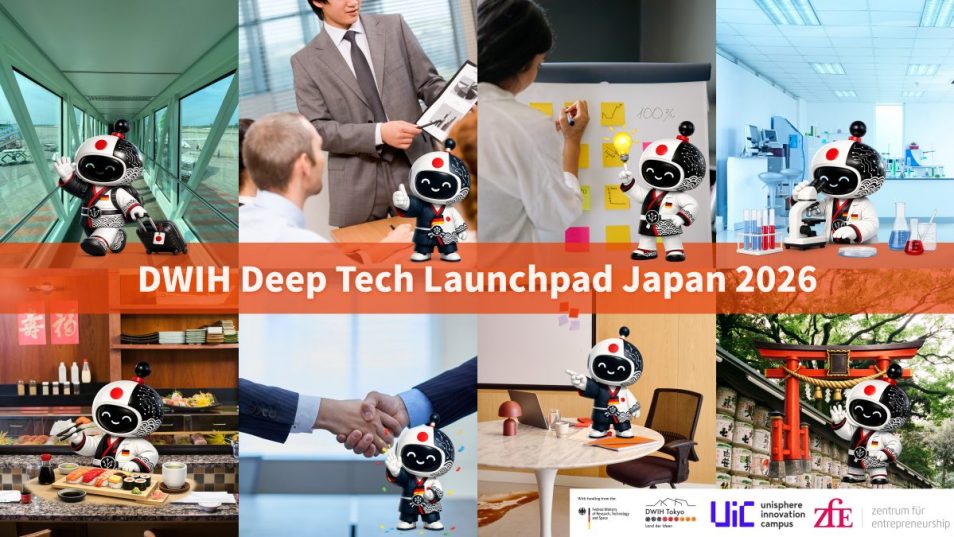
The DWIH Deep Tech Launchpad Japan 2026 is an exclusive, collaborative program offering research-based startups and sciencepreneurs from German universities a unique opportunity to explore the innovation and technology transfer ecosystems of Tokyo and the Kansai region (Kyoto/Osaka).
The program is specifically tailored for early-stage tech ventures (typically covering TRL 1–6) aiming to assess international potential, validate technology options, and connect directly with Japanese corporate partners, specialized deep-tech investors, and leading research institutions.
The DWIH Deep Tech Launchpad is jointly organized and conducted by the German Center for Research and Innovation Tokyo (DWIH Tokyo), the unisphere innovation campus, and the Center for Entrepreneurship (ZfE) at the University of Rostock, in cooperation with the supporter network of the DWIH Tokyo.
German Startups selected for the 2026 program
Adaept Engineering GmbH / Dr.-Ing. Arne Wall (Co-Founder & Managing Director)

Company Name: Adaept Engineering GmbH
Every machine speaks, we translate
Representative: Dr.-Ing. Arne Wall (Co-Founder & Managing Director)
Website/Company URL: https://adaept.de/
Status: Incorporated
Origin Institution (Location): University of Rostock (Rostock)
Technology Domain: Industrial IoT / Robotics & Automation / Smart Manufacturing
Short Description: Adaept Engineering builds industrial data pipelines connecting factory floor signals to modern applications through its modular software framework, OMNIBUS. The software seamlessly translates across 13 industrial protocols—including OPC UA, Modbus, CAN, and EtherCAT—and runs directly on resource-constrained microcontrollers (<2 MB RAM) as well as industrial PCs without proprietary platform lock-in, enabling rapid retrofitting, digital twin modeling, and MES/AI integration.
BoneTech: Timon Pahl (Software Development)

Company Name: BoneTech
BoneTech 3D-prints artificial bones that mimic real bone – inside and out – for implant testing and surgical training.
Representative: Timon Pahl (Software Development)
Status: Pre-incorporation
Origin Institution (Location): University of Rostock
Technology Domain: MedTech / Additive Manufacturing / Biomechanical Engineering
Short Description: BoneTech develops 3D-printed synthetic bone models that realistically replicate both the outer cortical bone and the complex, anisotropic trabecular micro-architecture of human bone in a single print. By converting patient CT scans via algorithmic clustering into mechanically accurate rod structures, BoneTech provides standardized, ethical alternatives to cadaver bone for orthopedic implant testing and surgical training, including underrepresented female, pediatric, and osteoporotic anatomies.
COFion: Eldho Sunny (Materials Development Lead)


Company Name: COFion
COFion develops advanced PFAS free materials for next generation proton exchange membrane technologies in hydrogen fuel cells and electrolysers.
Representative: Eldho Sunny (Materials Development Lead)
Website/Company URL: www.cofion.eu/
Status: Pre-incorporation
Origin Institution (Location): Technical University of Berlin (Berlin)
Technology Domain: Advanced Materials / CleanTech / Energy (Hydrogen & Fuel Cells)
Short Description: COFion develops advanced, PFAS-free materials for next-generation proton exchange membrane (PEM) technologies in fuel cells and electrolyzers. Based on patented research from TU Berlin, the platform utilizes tailored covalent organic frameworks (COFs) to resolve the critical trade-off between high proton conductivity, mechanical stability, and chemical durability without relying on conventional fluorinated polymers.
DiRec: Dr. Maike Gnutzmann (Co-CEO & CTO)

Company Name: DiRec
Closing the Loop: Tailor-made Battery Recycling
Representative: Dr. Maike Gnutzmann (Co-CEO & CTO)
Status: Pre-incorporation
Origin Institution (Location): University of Münster (Münster)
Technology Domain: CleanTech / Circular Economy / Battery Recycling & Energy Storage
Short Description: DiRec develops direct recycling technologies to efficiently regenerate and repair cathode active materials (CAM) from spent lithium-ion batteries without breaking them down into primary elements. By recovering, chemically regenerating, relithiating, and refinishing CAM from commercially available black mass, the process bypasses expensive hydrometallurgical re-synthesis and overcomes input-feedstock variations, delivering qualification-ready, high-performance cathode materials at lower costs and emissions.
GreenTens: Laura Springmann (Business Development)


Company Name: GreenTens
GreenTens turns upcycled CO₂ into dioxane-free, drop-in surfactants that cut production costs by 17% and CO₂ emissions by up to 70%
Representative: Laura Springmann (Business Development)
Status: Pre-incorporation
Website/Company URL: www.greentens.de
Origin Institution (Location): Technical University of Berlin (Berlin)
Technology Domain: Green Chemistry / CleanTech / Advanced Materials (CO₂-based Surfactants)
Short Description: GreenTens develops a patented platform technology for sustainable, non-toxic, and 1,4-dioxane-free non-ionic surfactants derived from upcycled CO₂. Manufactured via an ambient-pressure, energy-efficient synthesis process without relying on petroleum or palm oil, the resulting carbonate-ethoxylates offer tunable properties for detergents, industrial cleaning agents, lubricants, and emulsifiers with enhanced biodegradability and secure local supply chains.
MicroQuasar Technologies: Dr.-Ing. Laura Barillas-Mora (CEO)


Company Name: MicroQuasar Technologies
The world’s finest plasma pen
Representative: Dr.-Ing. Laura Barillas-Mora (CEO)
Website/Company URL: https://microquasartech.de/
Status: Pre-incorporation
Origin Institution (Location): Leibniz Institute for Plasma Science and Technology – INP (Greifswald)
Technology Domain: Advanced Materials / Semiconductor Equipment / MedTech
Short Description: MicroQuasar Technologies develops high-resolution atmospheric plasma-printing systems and OEM modules for next-generation semiconductor packaging and biochips. Featuring the world’s finest atmospheric plasma jet with feature sizes down to 30 µm, the maskless technology operates under open-air conditions, eliminating expensive vacuum chambers while offering multi-process capabilities from ultra-fine oxide cleaning to localized thin-film deposition.
Nexus Carbon: Dr. Peter Sponholz (CEO)


Company Name: Nexus Carbon
CO₂ becomes a product: Nexus Carbon turns biogenic CO₂ and renewable power into potassium formate, a chloride-free chemical the market already buys.
Representative: Dr. Peter Sponholz (CEO)
Website/Company URL: Website in preparation (no public URL yet)
Status: Pre-incorporation
Origin Institution (Location): University of Rostock & Leibniz Institute for Catalysis – LIKAT (Rostock)
Technology Domain: CleanTech / CCU (Carbon Capture & Utilization) / Green Chemistry
Short Description: Nexus Carbon converts biogenic CO₂ and renewable electricity directly into sustainable commodity chemicals through modular electrochemical cell stacks. Its first commercial application produces market-ready 50% potassium formate solution in a single catalytic step without fossil formic acid intermediates, providing an eco-friendly drop-in replacement for industrial coolants, airport de-icing, and concrete protection.
phageCTRL: Dr. rer. hum. Katharina Ekat (Team Lead)

Company Name: phageCTRL
phageCTRL develops bacteriophage-based anti-infective strategies for medical devices and biomaterials, enabling industry and research partners to harness the targeted antibacterial potential of phages in innovative medical applications.
Representative: Dr. rer. hum. Katharina Ekat (Team Lead)
Website/Company URL: https://imikro.med.uni-rostock.de/forschung/arbeitsgruppen/ag-phagectrl/blindagphagectrl-en
Status: Pre-incorporation
Origin Institution (Location): University of Rostock (Rostock)
Technology Domain: HealthTech / MedTech / BioTech (Infection Control & Phage Therapy)
Technology Domain: HealthTech / MedTech / BioTech (Infection Control & Phage Therapy)
Short Description: phageCTRL develops an integrated platform for personalized bacteriophage-based medicine to combat antimicrobial resistance and complex bacterial infections. By linking a quality-controlled phage library, standardized rapid diagnostic testing for phage susceptibility, and phage-functionalized biomaterials, the platform provides scalable and reproducible solutions for clinical infection prevention, wound management, and implant-associated care.
photomicAI: Dennis Sidin (CEO)

Company Name: photomicAI
Combining microbiology and artificial intelligence for aquatic ecosystems monitoring.
Representative: Dennis Sidin (CEO)
Website/Company URL: https://photomic.ai
Status: Pre-incorporation
Origin Institution (Location): University of Rostock & Fraunhofer IGD (Rostock)
Technology Domain: Artificial Intelligence / Blue Economy / Water Monitoring & Marine Tech
Short Description: photomicAI develops Cilium, a cloud-based AI software for automated plankton analysis in microscopic imagery to assess aquatic ecosystems and water quality. Combining deep convolutional neural networks and vision transformers trained on hundreds of thousands of expert-annotated organisms, the hardware-agnostic platform delivers object detection, species classification, pixel-accurate segmentation, and biovolume calculation within minutes, cutting manual analysis time by 95%.
wempyre: Christopher Spiegelfeld (CEO)


Company Name: wempyre
wempyre’s decentralized recycling container turns mixed plastic waste at factories into gas and energy on site, with no transport and no incineration.
Representative: Christopher Spiegelfeld (CEO)
Website/Company URL: https://wempyre.com
Status: Pre-incorporation
Origin Institution (Location): Berlin University Alliance via greenCHEM / innovate! lab (Berlin)
Technology Domain: CleanTech / Circular Economy / Hydrogen & Waste-to-Energy
Short Description: wempyre develops modular containerized high-temperature pyrolysis systems that convert up to one ton of mixed plastic waste per day directly on-site at industrial manufacturing plants into hydrogen, syngas, and clean energy. By utilizing a plasma-based heat source reaching up to 1,500 °C under complete exclusion of oxygen, the process emits zero CO₂ while transforming contaminated, non-mechanically recyclable plastic fractions into a decentralized, internal circular resource stream.
The Program at a Glance
- Travel Dates: November 21 – 28, 2026
- Locations: Tokyo & Kansai Region (Kyoto/Osaka), Japan
- Target Group: Sciencepreneurs, research-backed founders, and early-stage deep-tech startups affiliated with German universities or research institutions (ideally at PhD level or higher).
Partner Organizations & Quick Links
- University of Rostock: Center for Entrepreneurship (ZfE)
- unisphere innovation campus: Digitales Innovationszentrum Rostock GmbH
Funding & Background
The DWIH Deep Tech Launchpad Japan 2026 is a joint initiative under the new „DWIH Innovate“ program, funded by the German Federal Ministry of Research, Technology and Space (BMFTR). This global initiative aims to strengthen entrepreneurial mindsets at German universities and research institutions and advance the internationalization of technology transfer and unlock strategic innovation ecosystems for talents from Germany.
Parallel to the launchpad in Tokyo, similar international immersion programs for research-based startups and sciencepreneurs are scheduled for India (DWIH New Delhi) and the USA (DWIH San Francisco). A call for participation in these programs will follow shortly.
Veröffentlicht am: 12. November 2026